Composer Recap: 2025
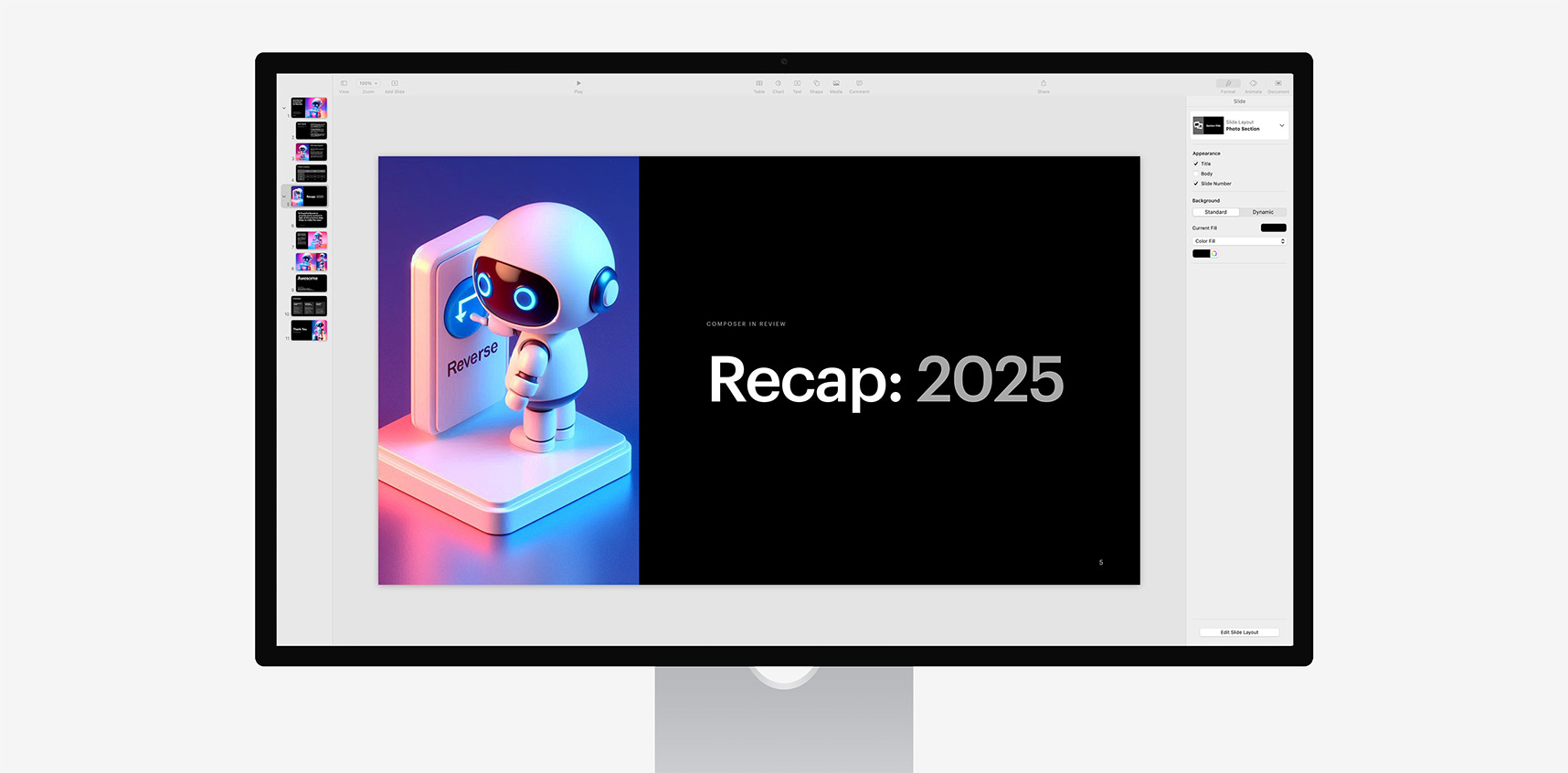
While we're not quite though Composer's first full year, saying goodbye to 2025 gives us a good opportunity to look back on some of what we've covered so-far, and some of what we're prioritizing heading into 2026.
Composer was just starting to take shape this time last year: we knew we'd be able to use Markdown as a base-level control language that would – in theory – bring together all of the stray bits of utility AppleScript routines we'd need to get a basic automation pipeline pulled together. Whether or not we could effectively build slides any more complex than a basic Title & Bullets layout was still very much an open question.
Today, we've cleared out the last of the waitlist and moved to General Availability around a fully-updated Library and a steady, stable core. Bug & Issue Reports have dwindled over the course of the v0.5 arc, and we've had a ton of feedback that's actively shaping what we're working toward for the v0.6 wave. While priorities have shifted around a bit since the initial launch, we're still largely on track toward the same North Star we set out for earlier in the year, albeit on a few re-ordered steps.
The 10,000ft View
First off, the Fun Stuff (data). We'd originally hoped to hit the 5,000 Slides Generated threshold by the time we wrapped up the Limited Access wave: you more than doubled that by the time we'd caught up. And where we'd initially load-tested up to the 150 Slide mark, we've since seen compositions cresting above 200 slides appearing in the logs.
The Chicago family is the run-away Top Theme Target thusfar – not entirely surprising given its Pilot status during the roll-out – and accounts for more than 4,500 of total Slides Generated. Generic targets are making their move on the overall count (predictably, as we started easing access restrictions), but account for only ~2500 Slides Generated thusfar.
And while we thought the Scaffold approach would be crucial for helping novices get started authoring this way, it turns out that nearly everyone is composing in plain Markdown at the end of the day – at a 70:1 ratio to be exact (more on that twist below).
All in all, off to an honest start (we think), given the Limited-Access rollout and general proof-of-concept vibe of the v0.5 engine: we hope to have a much broader view of things by this time next year.
The Gang's All Here*
Once Chicago was fully dialed in as a working Manual of Style for the Theme-level changes we'd need to make to bring this whole idea to life, our highest priority was getting the rest of the Library updated to Composer-Enhanced status across-the-board so we'd be iterating forward on a level baseline across the entire catalog.
We wrapped that process up in October with point updates to all but one *Problem Child: Aurora NXT exhibits type irregularities when some of the placeholders are manipulated with AppleScript, and we've sussed out that we'll need to rebuild the theme's core to get it working reliably: we've pulled Aurora from the shelf in the meanwhile, and will address at some point further down the road.
The remainder of our current Keynote catalog should work as intended for targeting purposes once you're up-to-date with the latest Theme Core(s) – and we've also refreshed each of the LE Themes on our Free Downloads page to ensure that Global Standard Routes are present and operable: the LE Themes are not yet integrated in the KeynotePro Theme Targeting selector, but are valid targets for the Custom Theme field if they're installed (or via Generic targeting if not).
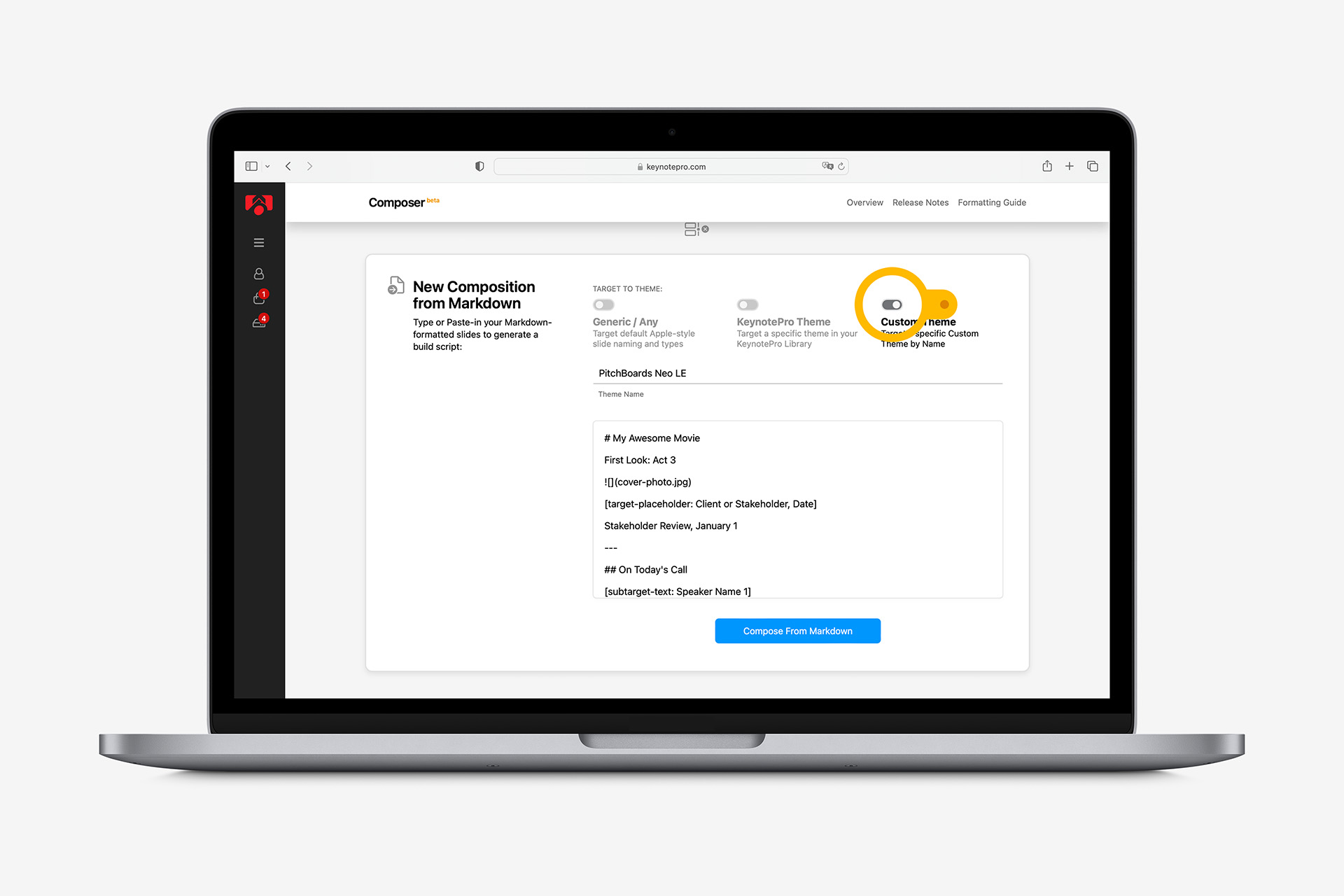
If you're targeting one of the updated (free) LE Themes, you can target it with the Custom Theme selector if it's already installed in Keynote - otherwise, stick to Generic.
Consensus Views
We saw a few recurring themes emerge over the course of the v0.5 wave, some of which we were pretty aware of heading in, others that came as a bit of a surprise along the way.
It really is a mess of windows. In an Edit/Revision loop, the combo of a Markdown editor, Composer in the browser, Script Editor to run the output, let alone Keynote itself – there's a lot going on. We can consolidate some of that by refactoring toward a native Mac app down the road if there's sufficient demand (which would also settle the notion of Offline mode) – for now, we're forging ahead on existing infrastructure and focusing on improvements that would naturally carry forward either way.
In the near term, there's almost universal consensus around the need for a real-time indication of how Composer's seeing each slide in your Markdown before it's submitted to Build. It would not only obviate the need for Scaffold being a separate pathway altogther (that 70:1 ratio), it would likely also cut down Edit/Revision loops, and – generally speaking – bring a lot more clarity to what's going to be built before it's actioned. So a Pre-Processing View has taken the lead in priorities for the coming v0.6 wave.
On the Engine itself, where we thought there would be a louder drumbeat by now around getting to some of the missing functional holes (looking at Charting & Audio/Video there), there's been less pressure than anticipated – so we've kicked those to the back-burner for the time being and will pull them back into the queue once the v0.6 UI changes are more fully
Onto v0.6 in '26
We're going to be bringing v0.6 online in stages in the coming months, and are hoping to have it settled in by the time we hit the actual Year One mark – we'll keep you posted on that front.
In the meanwhile, we'll continue addressing any issues that might surface on the v0.5 engine from an operational standpoint – so definitely continue to loop us in if you encounter any oddities.
We'd otherwise also like to extend our graitude to everyone who's taken part in the v0.5 wave thusfar – definitely a learing expereince here (we are, after all, primarily a theme systems shop), so we've really appreciated your patience with getting the engine settled in to steady-state, and look forward to focusing on making it even more useful over the coming year.
Additional Resources